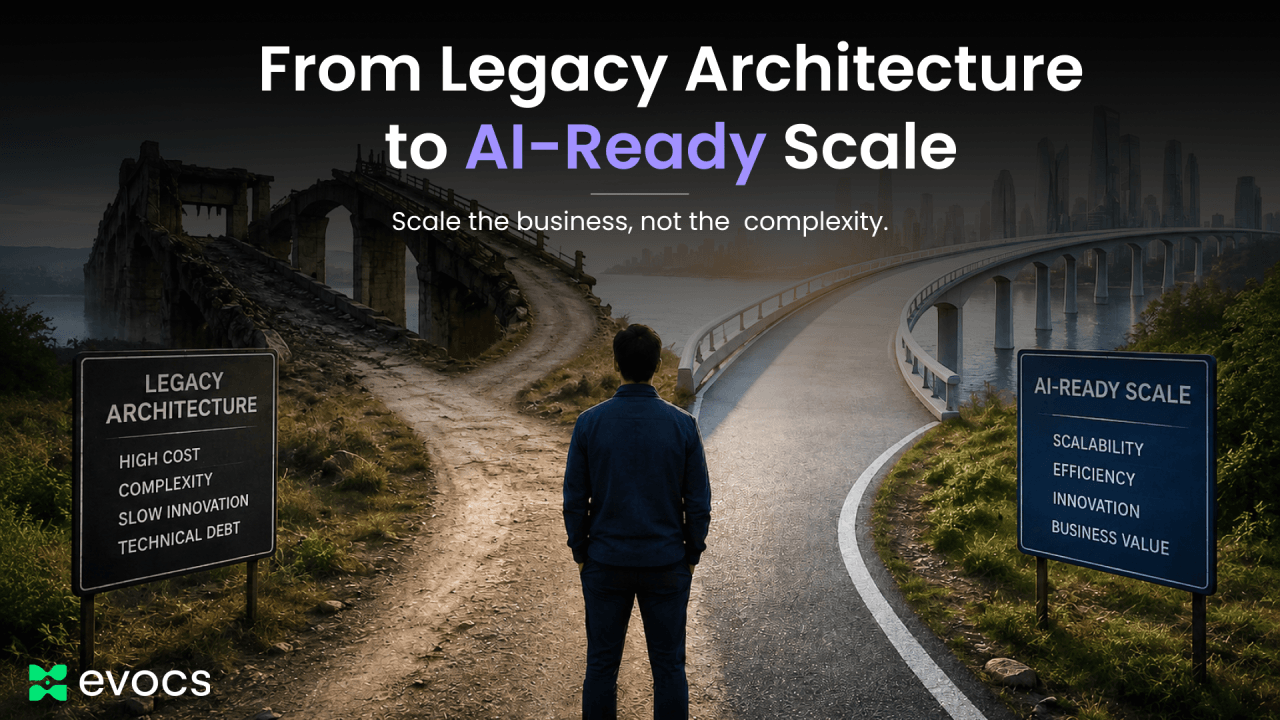
Enterprise growth should create leverage. As customers, transactions, products and data increase, the business should become better able to use its technology investments.
Yet many enterprises eventually reach a stage where growth starts making technology disproportionately expensive. Cloud bills rise faster than business volume, support teams expand, deployments become harder, integrations multiply and engineering teams spend increasing amounts of time maintaining what already exists.
The platform may still be functioning. Customers may still be getting served. New features may still be shipping. But underneath that activity, the economics of the technology estate are beginning to deteriorate.
Why should supporting the next million transactions require proportionally more infrastructure, engineering effort and operational cost?
McKinsey estimates that 10–20% of technology budgets intended for new products can be diverted toward resolving technical debt, while technical debt itself may represent 20–40% of the value of the technology estate.
Those numbers highlight an important distinction. An enterprise can continue investing heavily in technology without necessarily increasing its ability to move faster.
The real problem is not growth. It is an architecture that requires cost and complexity to grow along it.

When Architecture Stops Creating Operating Leverage
An architecture rarely stops scaling overnight. The deterioration is usually gradual, and the symptoms appear across different parts of the organization.
1. Finance: Cloud expenditure, infrastructure costs, licensing and application-support costs continue increasing.
2. Operations: Incident frequency rises, resolution takes longer and more activities depend on manual intervention.
3. Product: Releases slow down, testing cycles expand and relatively small features begin requiring changes across several systems.
4. Engineering: Teams deal with tightly coupled applications, duplicate services, legacy databases and growing integration dependencies.
Individually, these problems are easy to classify as cloud optimization, productivity, DevOps or application maintenance issues. Architecturally, they are often connected.
A tightly coupled application creates more regression testing and coordination. Duplicate services increase maintenance. Point-to-point integrations introduce more failure paths. Overprovisioned infrastructure increases cloud expenditure. Poor observability keeps experienced engineers investigating incidents instead of developing products.
As the estate becomes more complex, every new capability can carry an invisible tax: another dependency to maintain, another integration to test, another environment to monitor or another team required to approve a change.
That is when scale starts producing complexity instead of leverage.
Architecture Is Also an Economics Problem
Technology cost is usually discussed through visible budget categories such as cloud, people, licences and infrastructure. Architecture determines how efficiently many of those resources are consumed.
Consider two platforms processing the same increase in transaction volume. One can automatically scale resources, isolate workloads and allow teams to deploy independently. The other requires permanent spare capacity, coordinated releases, manual intervention and extensive regression testing.
Both platforms may successfully process the additional transactions. But their economics are completely different.
This is why cost reduction without architecture improvement can treat the expense rather than the mechanism creating it.
AWS reports that CSL achieved approximately 30% operational cost savings following cloud transformation. In another AWS modernization case, Meliá Hotels reported:
60% cost savings
2× availability-processing capacity
75% improvement in time to market
These examples should not be interpreted as evidence that every enterprise should follow the same modernization pattern. The more useful lesson is that architecture decisions eventually surface as measurable business outcomes.
What architectural changes would prevent cost from returning as the business continues growing?

Modernization Should Begin With Diagnosis
One of the most expensive modernization mistakes is selecting the solution before understanding the problem.
Organizations often jump directly to:
1. Cloud migration
2. Microservices
3. Kubernetes
4. Application rewrites
5. GenAI
6. Another observability platform
Every one of these technologies can create value. None should automatically be the starting point.
A monolith, for example, is not inherently a problem simply because it is old. If it is stable, economical and allows the business to release quickly, rewriting it may destroy value rather than create it.
Similarly, moving an inefficient application to cloud infrastructure does not automatically make the application efficient. Breaking a poorly understood system into microservices can turn internal code complexity into distributed-system complexity.
Modernization therefore needs diagnosis before prescription.
Enterprises need to understand:
1. What is actually driving cost?
2. Where are the architecture bottlenecks?
3. Which dependencies are limiting scale?
4. Which systems should be retained, consolidated, modernized or retired?
5. Where is engineering effort being repeatedly consumed?
6. Which constraints will become more expensive as transaction or customer volume increases?
This is the purpose of the As-Is assessment.

Where Archon Fits
Archon provides the assessment and recommendation layer between the current architecture and the future operating model.
Rather than looking at a single technology in isolation, the assessment examines five connected areas:
1. Applications: Topology, dependencies, legacy technologies, service boundaries and code complexity.
2. Infrastructure: Compute, storage, network, cloud usage, capacity and utilization.
3. Data: Databases, duplication, movement, dependencies and integration patterns.
4. Operations: Deployment, monitoring, incidents, support effort and manual activity.
5. Economics: Infrastructure cost, application-support cost, licensing, engineering effort and operational overhead.
The value comes from connecting these layers.
A recurring incident may appear to be an infrastructure problem but originate in duplicated application components. High cloud expenditure may look like a capacity issue when the deeper problem is an application that cannot scale down. Slow releases may appear to be a developer-productivity issue while the underlying constraint is tightly coupled services and shared data.
How Archon Connects the As-Is to the To-Be
Archon helps enterprises move from understanding the current environment to defining a practical modernization roadmap. The assessment maps the As-Is architecture and identifies where technical structure is creating unnecessary cost, operational friction or scaling constraints.
Modernization priorities can then be linked to specific outcomes:
1. Rightsizing and autoscaling to reduce infrastructure waste
2. Selective modularization to improve release velocity
3. Deployment automation to reduce operational effort
4. API or event-driven architecture to simplify integrations
5. Improved observability to reduce incident-investigation time
6. Data rationalization to remove duplication and synchronization problems
7. AI-assisted engineering where repetitive work can be reduced
This also helps enterprises avoid the assumption that everything needs to be modernized simultaneously.
The strongest To-Be architecture is not necessarily the one containing the newest technology. It is the one that creates better operating leverage.
Where is today’s architecture consuming unnecessary money, slowing product development or preventing scale?
Modernization Priorities Should Follow Business Impact
Legacy estates can contain hundreds of applications, integrations and infrastructure components. Treating every outdated component as equally urgent creates expensive transformation programmes with unclear returns.
Prioritization should instead consider the economic effect of each constraint.
For example, an older internal application serving a stable workload may require little attention. A duplicated service generating recurring incidents and consuming hundreds of engineering hours deserves much higher priority.
Similarly, a database modernization programme should not be justified simply because the database is old. It becomes strategically important when schema debt, duplicated information or coupling directly limits releases, reliability or scaling.
This changes modernization from a technology refresh programme into a portfolio of business interventions.
The question moves from “How much legacy technology do we have?” to “Which architectural constraints are costing us the most?”

AI Adoption Does Not Automatically Create AI Productivity
The same discipline is increasingly important with AI.
Enterprises are adding copilots, GenAI applications, AI infrastructure, data pipelines and automation platforms at speed. But deploying more AI does not automatically make the organization more productive.
In some cases, AI can actually add another layer of operating cost.
Common reasons include:
1. Additional compute without measurable productivity gains
2. Multiple AI tools solving overlapping problems
3. New integrations added to already complex environments
4. AI inserted into workflows that remain largely manual
5. Licensing costs without sufficient adoption
6. AI projects built without reliable access to underlying enterprise data
AI adoption is not the same as AI productivity.
The useful question is not simply “Where can we deploy AI?” It is “Where can AI remove measurable cost, effort or delay?”
That might mean reducing the time required to understand a legacy codebase, automating documentation that engineers currently maintain manually, generating tests during refactoring, correlating operational logs or identifying infrastructure anomalies earlier.
AI can support modernization through:
1. Architecture discovery
2. Dependency mapping
3. Code explanation and refactoring
4. Legacy-framework migration
5. Automated documentation
6. Test generation
7. Incident triage
8. Log correlation
9. Capacity forecasting
McKinsey has described a transaction-processing modernization previously expected to cost more than $100 million being estimated at less than half that amount using GenAI-assisted approaches. AWS also cites research suggesting GenAI-assisted migration can reduce migration time by approximately 30–40%.
The opportunity is therefore larger than putting AI into the customer-facing product. AI can also change the cost and speed of building, modernizing and operating the technology estate itself.
Archon can help identify where those opportunities exist and where introducing AI would simply add complexity without enough economic return.
Case Study: A Year-Old Problem Found in Four Weeks
A platform-engineering organization running a document-processing estate engaged EVOCS after a recurring defect had remained unresolved for more than a year.
The estate included a monolith, a processing pipeline and several external integrations. The platform had been built under genuine commercial pressure and continued operating, but nobody inside the organization had a complete view of how the system behaved as a whole.
The initial assessment surfaced three significant problems:
1. 997 open work items
2. 78.3% of the backlog had no reliable owner
Support, DevOps and Development were seeing different symptoms of the same underlying fault Archon approached discovery seat by seat rather than subject by subject. This allowed the assessment to understand how the same platform looked from Support, DevOps and Development instead of treating each team’s symptoms as unrelated issues.
The full 997-item work portfolio was audited for ownership, age and duplication, while the diagnostic process correlated concurrent users, documents processed and latency.
The technical root cause was eventually traced to a rendering component duplicated across six modules without lifecycle control. Those duplicated implementations were creating orphaned processes and pod failures under memory pressure.
The Results
1. 4 weeks to complete the assessment versus an 18-week manual baseline
2. Unowned backlog reduced from 78.3% to approximately 12%
3. One rendering service replaced six duplicated implementations
Approximately 576 engineering hours per year reclaimed from duplicate tracking. The defect that had remained unresolved for more than a year was resolved within the engagement window
The case demonstrates why diagnosis matters. What appeared repeatedly as a capacity problem was also a structural architecture, lifecycle-management and ownership problem.
Increasing infrastructure alone would not have addressed the underlying cause.
Case Study: 4× Faster Releases From a Coupled Platform
Another EVOCS Archon engagement involved a mid-market SaaS platform providing automated risk-scoring and verification decisions.
The environment used Node.js and React on Kubernetes, a Python scoring engine and a shared relational database of roughly 2 TB carrying several years of accumulated schema debt.
Its architecture had several structural constraints:
1. Non-contract APIs between the application and scoring engine
2. No authentication boundary between services
3. No queue between the two services
4. Autoscaling configured but effectively unused
5. Duplicate data drifting out of sync
6. Business logic distributed across hundreds of stored procedures
The immediate temptation could have been a large-scale rewrite.
Instead, Archon captured the current architecture, identified the structural causes and modelled the target state. Modernization was then sequenced according to risk.
The transformation moved through five stages:
1. Authentication extraction
2. Scoring-engine modernization
3. Front-end consolidation
4. Database abstraction
5. Full data-platform modernization
The sequence mattered. Higher-risk data-platform work came later, once abstraction contracts had been proven in production, allowing the platform to remain live throughout the transformation.
The Results
Deployment frequency increased 4×, from monthly to weekly
Data-sync defects decreased by 65%
Idle compute cost declined by approximately 25%
Scale-from-zero replaced the permanent fixed pod floor
Release velocity improved without increasing rollback rate
This is what modernization tied to economic outcomes looks like. The objective was not simply to introduce microservices. The architecture was changed in ways that reduced defects, improved release speed and removed unnecessary compute cost.
What Leaders Should Take Away
Architecture modernization should not begin with a technology purchase.
Before investing in the next migration, platform, microservice initiative or AI programme, leadership should ask:
Where is growth creating disproportionate technology cost?
Which architectural constraints are slowing engineering and product delivery? • Which systems genuinely need modernization?
Which existing systems can safely remain unchanged?
Where can automation or AI remove measurable operational effort?
What financial or operational metric should each modernization initiative improve? A scalable architecture is not simply one that survives higher traffic.
It is one that allows customers, transactions, products and engineering teams to grow without infrastructure cost, support effort and engineering complexity increasing at the same rate.
Conclusion
Modernization should ultimately change the economics of growth.
If doubling transaction volume requires doubling infrastructure, support effort and engineering complexity, the platform may be scaling technically, but it is not scaling economically.
The same principle applies to AI. Deploying more AI tools does not automatically create a more productive enterprise if those tools are layered onto fragmented systems, unclear dependencies and inefficient workflows.
A stronger transformation sequence is to understand the As-Is environment, identify the constraints that matter economically, prioritize modernization according to business impact and apply AI where it can remove measurable effort or accelerate change.
Archon provides the bridge between those decisions by making the current environment visible and connecting architecture findings to cost, scalability, reliability and product velocity.
The goal of modernization is therefore not simply to replace legacy technology with cloud, microservices or AI.
It is to build an operating model in which the enterprise can serve more customers, process more transactions, launch more products and make more changes without requiring cost and complexity to rise at the same rate.
That is when architecture stops being a constraint on growth and starts becoming a source of operating leverage.
Source: https://www.linkedin.com/pulse/from-legacy-architecture-ai-ready-scale-yogesh-sahu-futnf/